ID Verification and KYC Workflow
1. Overview
This article describes the ID verification and KYC workflow that Ashta performs for every investor onboarded onto the platform. It covers:
- Document and biometric verification at onboarding
- Data-source identity verification on every transaction
- Annual re-verification and ongoing monitoring
- Watchlist screening (sanctions, PEP, adverse media, fitness & probity, warning lists)
- Records retention, audit trail, and data security
For investors that are entities (corporations, trusts, LLCs, etc.), KYC is performed on every natural person connected to the entity, and entity formation documents are collected and retained on file for any manual KYB review compliance may require.
A bank, custodian, or regulator asks how your fund verifies its investors; you're onboarding a new compliance officer; or you're preparing documentation for an annual audit. Content is written for fund administrators and compliance teams operating on Ashta — feel free to quote or adapt it for your own institutional due-diligence responses.
2. Scope of Verification
| Investor Type | Verification Type Performed |
|---|---|
| Individual investors | KYC (identity, compliance screening, suitability) |
| Joint accounts | KYC on each account holder |
| Corporations, LLCs, LPs, Trusts, SPVs | KYC on every Ultimate Beneficial Owner (UBO), director, and authorised signatory of the entity. Entity formation documents (incl. Certificate of Incorporation) are collected and retained for manual KYB review where compliance requires. |
| Registered accounts (RRSP, TFSA, IRA, etc.) | KYC on the beneficial owner |
No investor funds are accepted, and no subscription documents are released, until verification is complete and a positive compliance decision is recorded against the investor profile.
3. Onboarding Workflow — End-to-End
Every investor passes through the following gated workflow before they are permitted to subscribe:
- Account creation — investor self-registers; email is verified via single-use token.
- Profile completion — personal/corporate details, residency, employment, source of funds.
- Suitability questionnaire — risk profile, investment objectives, income, net worth, and (where applicable) accreditation declaration.
- Identity verification — automated by the Ashta platform (see Section 4).
- Compliance screening — automated by the Ashta platform (see Section 5).
- Risk classification — investor is assigned Low / Medium / High / Critical risk (see Section 6).
- Decisioning — automated pass / fail, with mandatory human review for any non-pass outcome (see Section 8).
- Subscription — only investors with a Cleared compliance status can subscribe to a deal.
Every stage is timestamped, logged, and attributable to the user or system process that performed it.
4. Identity Verification
The Ashta platform performs identity verification on every individual investor (and on every UBO / signatory for entity investors). Verification is performed against authoritative external data sources and consists of two complementary checks.
4.1 Document-Based Verification (at onboarding)
The platform captures and verifies a government-issued photo identification for every individual investor (and every UBO, director, and authorised signatory of an entity investor):
- The platform supports verification across 12,500+ identity document types issued by 230+ countries and territories. A detailed list is available at countries.ashta.ai/ashta-supported-countries.pdf.
- The document is validated for authenticity (security features, tampering, expiry).
- A live selfie is captured and matched biometrically to the identification document. Liveness detection prevents the use of static images, screens, or masks.
- The captured name, date of birth, and document number are extracted via OCR and reconciled against the data the investor provided in Section 3.
The verification is performed by an AI-driven engine for speed and accuracy, producing a recommendation of Approved, Declined, or Resubmit. Your administrators retain ultimate authority to review and override the recommendation before the investor's KYC status is finalised.
The identification document itself is collected and retained in an isolated, encrypted S3 bucket dedicated to your tenant. Access follows a Least-Privilege model — files are retrieved only via time-limited (2-minute) pre-signed URLs, ensuring no persistent direct access to the underlying object. Retention policy is detailed in Section 10.
4.2 Data-Source Verification — Single Source and Dual Source
Separate from the document-and-biometric verification in Section 4.1, the platform performs a data-source identity check against authoritative third-party reference data. This check is re-run from scratch on every new transaction the investor initiates — not just once at onboarding — and every run produces an independent verification report retained for the full regulatory retention period (Section 10).
For each run, the platform submits the investor's name, date of birth, and residential address and receives two complementary results in a single response:
- Single-Source Result — a match against one independent, authoritative identity reference source, with a field-by-field outcome (last name, first name, middle name, street number, street name, city, postal code, province, date of birth) and any data-quality warnings (e.g., suffix mismatch, prior-address gap).
- Dual-Source Result — a match against two independent authoritative reference sources. Dual-source matching is the standard required under Section 105 of the Proceeds of Crime (Money Laundering) and Terrorist Financing Regulations (Canada) for non-face-to-face individual identity verification.
A positive KYC outcome is recorded when either the single-source or the dual-source result returns a pass. Both outcomes — and their underlying field-level detail — are persisted in every verification report, regardless of which method produced the pass.
Where a check fails, or where compliance requires a fresh run on demand, your administrators can re-trigger the verification directly from the admin panel. Every trigger, every re-run, and every override is audit-logged with actor identity, timestamp, and rationale.
A verbatim sample of the verification report produced by this check is attached as Appendix A.
4.3 Outcomes Recorded
Each identity verification produces one of the following outcomes, persisted to the investor's record:
- Pass — both document and data-source checks succeeded.
- Resubmission Required — image quality or document issue; investor is re-prompted.
- Failed — possible fraud or document tampering; routed to manual compliance review.
- Skipped (with reason) — applicable only where regulatory exemption applies; reason is recorded.
5. Compliance Screening
In parallel with identity verification, every investor (and every UBO / authorised signatory of an entity investor) is screened against the following watchlists by the Ashta platform:
| Screening List | What It Catches |
|---|---|
| Sanctions Lists | Individuals and entities sanctioned by OFAC (US), HM Treasury / OFSI (UK), EU Consolidated, UN Security Council, OSFI (Canada), and other major regimes. |
| PEP Lists (Politically Exposed Persons) | Domestic and foreign political figures, their close associates and family members, who pose heightened bribery / corruption risk. |
| Adverse Media Lists | Negative news coverage relating to financial crime, fraud, regulatory action, or other reputational risk. |
| Warning Lists | Regulator-issued investor warning lists (e.g., SEC, FINRA, OSC, BCSC) identifying individuals or firms subject to enforcement action. |
| Fitness & Probity Lists | Individuals barred or restricted from holding regulated financial roles. |
5.1 Screening Cadence
Watchlist screening is performed at two defined points:
- At onboarding, alongside the identity verification in Section 4.
- Annually thereafter, as part of the mandatory full re-verification (see Section 9.2). Every annual refresh re-runs all five screenings against the most current versions of the lists.
Between annual refreshes, screening is not run automatically. However, your compliance team may trigger an additional screening at any time through the admin panel — for example, in response to a regulator request, adverse news, or a change in the investor's risk profile. Any such ad-hoc screening is audit-logged.
Any positive hit suspends the onboarding workflow (or blocks the investor from proceeding to a new transaction, in the annual-refresh case — see Section 9) and routes the investor's file to your compliance team for manual review and disposition. Outcomes are recorded as: No match · Match (under review) · Cleared (false positive) · Confirmed (true positive). Confirmed true positives are rejected and cannot subscribe.
5.2 Example Screening Result
A typical clean screening record for an investor:
- ✅ No matches were found from Adverse Media lists
- ✅ No matches were found from Fitness & Probity lists
- ✅ No matches were found from PEP lists
- ✅ No matches were found from Sanctions lists
- ✅ No matches were found from Warning lists

Screenshot: Compliance Checks panel from a real investor verification record (test data). Each list is checked independently; the result is recorded against the investor profile and retained per the retention policy in Section 10.
6. Risk Classification
Following identity verification and compliance screening, every investor is assigned a risk rating based on:
- Country of residence and country of citizenship (FATF, EU, and your fund's defined high-risk lists).
- Source of funds.
- PEP / adverse media proximity.
- Investor type (individual vs. corporate vs. trust).
- Accreditation status and net-worth band.
Investors flagged High or Critical are subject to Enhanced Due Diligence (EDD), which includes additional source-of-funds documentation, beneficial-owner verification beyond minimums, and senior compliance sign-off.
7. Corporate, Trust, and Entity Investors
When the subscriber is an entity (corporation, LLC, LP, trust, SPV, family office, foundation, etc.), Ashta's verification approach is to perform full KYC on every natural person connected to the entity, supported by collection of the entity's formation documents.
7.1 Entity Documents Collected
The following entity-level documents are collected at onboarding and retained against the investor's file:
- Certificate of Incorporation or formation document
- Articles, constitution, or trust deed
- Current register of directors and officers
- Register of members / shareholders or capitalisation table
- Proof of registered office address
- Tax identification number (e.g., BN, FEIN, ABN)
- Where applicable, regulatory licence (e.g., for regulated entity investors)
These documents serve two purposes: they identify the natural persons behind the entity for the KYC steps in Section 7.2, and they remain on file for manual KYB review by your compliance team where the investor's risk profile, transaction pattern, or regulator request warrants it.
Automated entity-level KYB (e.g., live verification against corporate registries, entity sanctions screening) is on the platform roadmap and is not currently performed at the platform level.
7.2 Full KYC on Every Connected Person
Every one of the following is verified as if they were an individual investor, with the full identity verification (Section 4) and compliance screening (Section 5) controls applied:
- Each Ultimate Beneficial Owner (UBO) holding ≥ 25% beneficial interest (threshold configurable per fund / per jurisdiction)
- Each director / officer
- Each authorised signatory acting on behalf of the entity
- For trusts: settlor, trustee(s), protector (if any), and named beneficiaries
This means that for every entity investor, every natural person with control or material interest passes through document-based identity verification, biometric matching, single- or dual-source data verification, and screening against sanctions, PEP, adverse media, warning, and fitness & probity lists. No entity is permitted to subscribe until all required connected persons are individually cleared.
8. Decisioning, Review, and Override
- A successful, fully-automated pass on identity verification, compliance screening, and risk classification moves the investor to Cleared status.
- Any fail, partial match, resubmission, or EDD trigger suspends automation and requires manual review by your authorised compliance reviewer.
- Manual decisions (including any override of an automated outcome) are logged with:
- Reviewer identity
- Timestamp
- Documented rationale
- Supporting documentation reference
No investor can be moved to Cleared without an audit-attributable decision.
9. Ongoing Monitoring and Re-Verification
After initial onboarding, the platform applies the following ongoing controls.
9.1 Per-Transaction Data-Source Re-Verification
Every new transaction an investor initiates triggers a fresh run of the data-source identity check described in Section 4.2 — name, date of birth, and address re-submitted to authoritative reference data; single-source and dual-source results returned. No result is cached or reused from a prior transaction. A separate verification report is produced and retained for every transaction.
9.2 Annual Full Re-Verification
The onboarding-grade verification — document-based identity (Section 4.1), biometric / liveness, and watchlist screening across all five regulatory categories (Section 5) — has a one-year validity. After 12 months, the investor's verification status reverts to requires re-verification. The natural re-trigger point in the calendar year is tax-statement season.
Until the investor completes the annual re-verification, two hard gates apply, both enforced platform-wide:
- The investor cannot initiate any new investment transaction.
- The investor cannot download their tax documents (K-1, T5013, 1099) for the current tax year.
Neither gate can be bypassed by the investor; both lift only on successful completion of the full annual re-verification.
9.3 Trigger-Based Re-Verification
A re-verification can be triggered outside the annual cycle in response to:
- Material profile changes (residency, name, ownership structure).
- A regulator request or your compliance team initiative.
- Adverse media surfaced through external channels.
- Unusual transaction patterns.
Your administrators can re-trigger any verification step — identity verification, data-source check, or watchlist screening — at any time from the admin panel. Every trigger, result, and override is audit-logged.
10. Record Retention and Audit Trail
The Ashta platform maintains a tamper-evident audit trail for every action taken on every investor record. The audit trail includes:
- All status transitions (with before / after, timestamp, and actor).
- Every document captured (with hash, upload time, and uploader).
- Every screening result (including the result payload and reference sources).
- Every manual review decision and rationale.
- Every login and access event.
10.1 KYC / AML Verification Report Retention
Every identity-verification run produces a complete, standalone verification report (see Appendix A for a verbatim sample). All such reports are retained for the regulatory retention period — including reports from prior verifications when an investor is re-verified at a later date. No prior report is overwritten, deleted, or replaced when a new verification is performed.
Compliance staff can retrieve every report ever produced for an investor against a given subscription through the Previous KYC Reports view on the transaction record. Each report is independently timestamped, has its own immutable identifier, and is individually downloadable:
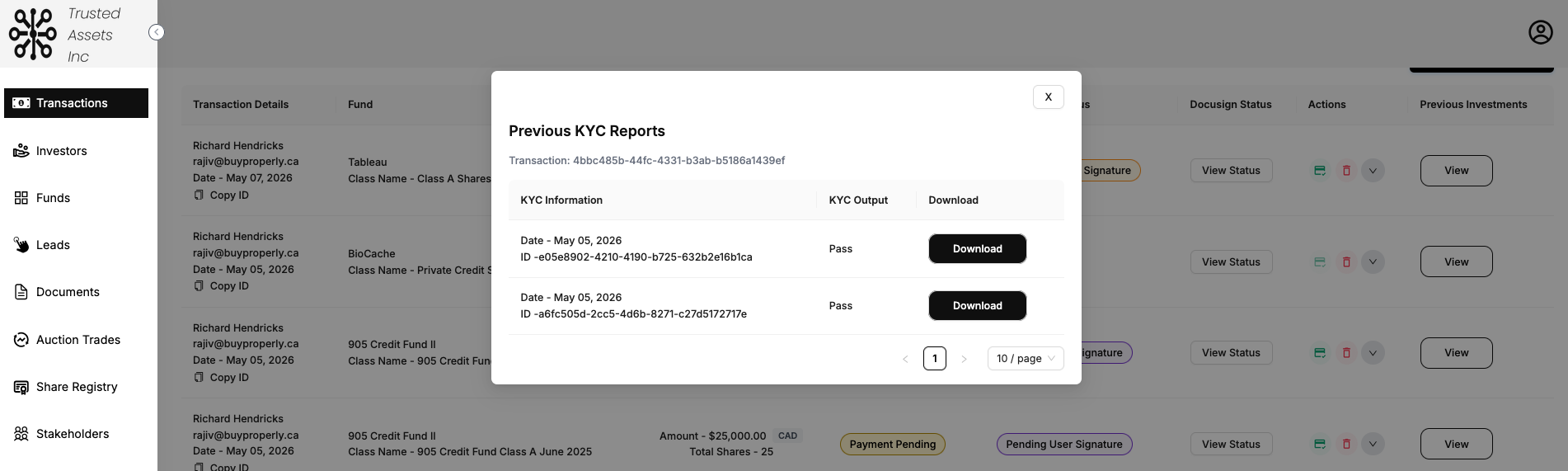
Screenshot: Previous KYC Reports modal on a real investor transaction (test data). The view lists every identity verification ever run against this subscription, each preserved as a standalone, downloadable record.
10.2 Retention Policy
Records — including verification reports, document captures, screening results, manual review decisions, and audit trail entries — are retained for the duration of your service agreement with Ashta, or for 5–7 years, whichever is longer, in line with FINTRAC, FinCEN, and applicable EU AMLD record-keeping standards.
Custom retention schedules are supported on a per-fund basis where particular regulatory regimes, fund-of-funds arrangements, or investor agreements require a different period.
On contract termination, or on your explicit deletion request:
- Data is programmatically removed from active storage.
- The corresponding database records are scrubbed.
- The audit log of the deletion event itself is retained per the same retention policy.
The audit trail can be exported on request in human-readable PDF and machine-readable CSV / JSON formats for regulator or auditor review.
11. Data Security and Privacy
- All investor data is encrypted in transit (TLS 1.2+) and at rest (AES-256).
- Personal identification documents and biometric data are stored in isolated, encrypted S3 buckets dedicated to your tenant — investor data is not commingled with other funds' data.
- Access follows a Least-Privilege model: stored files are never directly addressable. Every retrieval is brokered through a time-limited (2-minute) pre-signed URL issued only to authorised users, ensuring that no persistent or long-lived link to the underlying object exists.
- Access to investor PII inside your tenant is restricted by role-based access control; every access event — including each pre-signed URL issuance — is logged.
- The platform is hosted within isolated, single-tenant infrastructure dedicated to your fund.
- The platform provider operates under an active SOC 2 controls programme, with web application firewall, intrusion detection, and continuous security monitoring.
- Investor personal data is processed in accordance with PIPEDA (Canada), GDPR (where applicable), and the privacy laws of the investor's jurisdiction.
12. Summary
Ashta operates a multi-layered investor verification programme that combines document and biometric identity verification at onboarding, per-transaction data-source identity checks, annual full re-verification, and continuous record retention. Every investor — and every beneficial owner behind an entity investor — is subject to identity verification, watchlist screening across five regulatory categories, risk-based classification, and ongoing monitoring. No investor funds are accepted until a documented compliance decision has been recorded against the investor profile. Every step is logged, attributable, and exportable for regulator or auditor review.
If you have questions about a specific investor's verification record, contact your Ashta account team or use the admin-panel re-trigger flow described in Section 9.3.
Appendix A — Sample KYC / AML Verification Report
The following is a verbatim sample of the KYC / AML verification report produced by the platform for each identity verification performed on an investor. Personal data shown is from a test investor record.
===================================
KYC / AML VERIFICATION REPORT
===================================
Investor:    Sarah Yoneaml
Email:       rajiv@buyproperly.ca
Transaction: b42b48d6-9208-40b9-82d8-4962088542cd
Date:        May 07, 2026, 7:26 AM

-----------------------------------
RESULT: PASSED
-----------------------------------
Single Source Verification: Passed
Dual Source Verification:   Failed
Overall:                    Passed
(Passes if either single or dual source passes)

-----------------------------------
SUBMITTED INFORMATION
-----------------------------------
  Name:          Sarah Rita Yoneaml
  Date of Birth: 1961/01/15
  Address:       1, Yonestreet, Toronto, Ontario, M3H3P1

-----------------------------------
SINGLE SOURCE - VERIFICATION RESPONSE
-----------------------------------
  Last Name               Matched
  First Name              Matched
  Middle Name             Matched
  Name Suffix             Not Provided
  Street Number           Matched
  Street Name             Matched
  City                    Matched
  Postal Code             Matched
  Province                Matched
  Date of Birth           Matched
  Previous Address        Z
  2nd Previous Address    Z
  Address Reported        Jul 2025
  DOB on File             Jan 15, 1961
  Name on File            YONEAML,SARAH,RITA,SR
  Address on File         1,YONESTREET,TORONTO,ON,M3H3P1

-----------------------------------
WARNINGS
-----------------------------------
  CAUTION - SUFFIXES ARE UNEQUAL

-----------------------------------
CREDIT FILE DETAILS
-----------------------------------
  Waterfall Process Used  No
  Credit File Origin      CANADA
  Credit File Created     Dec 30, 2009
  Trades on File          004
  Oldest Trade Opened     Jan 02, 2014
  Equifax File Number     0049982945
  Hit Code                4 (CONSUMER DECLARATION)
  Hit Strength            11 (Regular hit)
What this report demonstrates to the reviewer:
- Both checks were attempted (single and dual) and the decision logic is explicit on the face of the report.
- Field-by-field match detail is recorded for the single-source check, so any reviewer can trace exactly which identifying attributes matched authoritative data.
- Data-quality warnings are surfaced, not hidden — in this case a suffix mismatch was logged even though the overall result was a pass.
- The investor's identity has independent third-party history — the credit file in this case was first created in December 2009, providing a 16-year audit trail behind the identity attestation.
- Every report is uniquely identifiable by transaction ID and KYC ID, enabling independent retrieval and chain-of-custody for compliance review.
A standalone copy of this report file is held against the investor's transaction record and can be retrieved by your administrators through the Previous KYC Reports view (see Section 10.1).